A friend of mine bought a house last year. When I asked how she picked her agent, she didn't mention commission rates or market expertise or how fast he answered the phone. She said this: "When we toured the second house, he asked if the backyard was big enough for Biscuit."
Biscuit is her dog. She had mentioned him once, in passing, three weeks earlier.
That agent is going to get every referral she has for the next decade. Not because he's the best negotiator in the city. Because he made her feel like a person instead of a transaction.
The detail is the relationship
If your work runs on relationships, and advising, recruiting, selling, and consulting all do, then you already know that trust is the whole game. What's easy to miss is how trust actually accumulates. It's rarely the big gestures. It's the moment a client realizes you remembered something they told you when they weren't trying to be remembered.
Asking about the daughter's graduation. Knowing they hate morning meetings. Remembering that last quarter they were worried about a supplier, and opening with "did that situation ever get resolved?"
Each of those takes ten seconds to say. Each one lands with weight completely out of proportion to the effort, because it signals something people almost never feel in a business context: you were actually listening.
The honest math
Here's the problem. A working advisor or agent might have 150 active relationships. Each of those people has a partner, kids, a job situation, health stuff, plans, worries. Call it ten meaningful details per person that change over time. That's 1,500 moving facts, and every one of them was mentioned exactly once, usually while you were thinking about something else.
Nobody's brain holds that. The professionals who seem to remember everyone aren't gifted. They have a system. For decades the system was index cards or a fat CRM full of fields nobody filled in. The card system worked because the great ones wrote things down right after the conversation. The CRM mostly failed because typing structured data into forms at 6 pm is a chore, and chores lose.
A system you'll actually keep
Whatever tool you use, the system that works has three parts, and none of them takes more than two minutes:
- Capture right after. The moment a client call or meeting ends, get the personal details out of your head. Not the deal notes, your CRM has those. The human ones: the kid's name, the trip, the worry, the joke that landed.
- Review right before. Before you see someone, spend one minute on what you know. Walk in with one personal question ready. One is enough.
- Let something watch the clock. The relationships that quietly go cold are the ones nobody scheduled. Decide how often your key people should hear from you, and let a tool tell you when you've drifted.
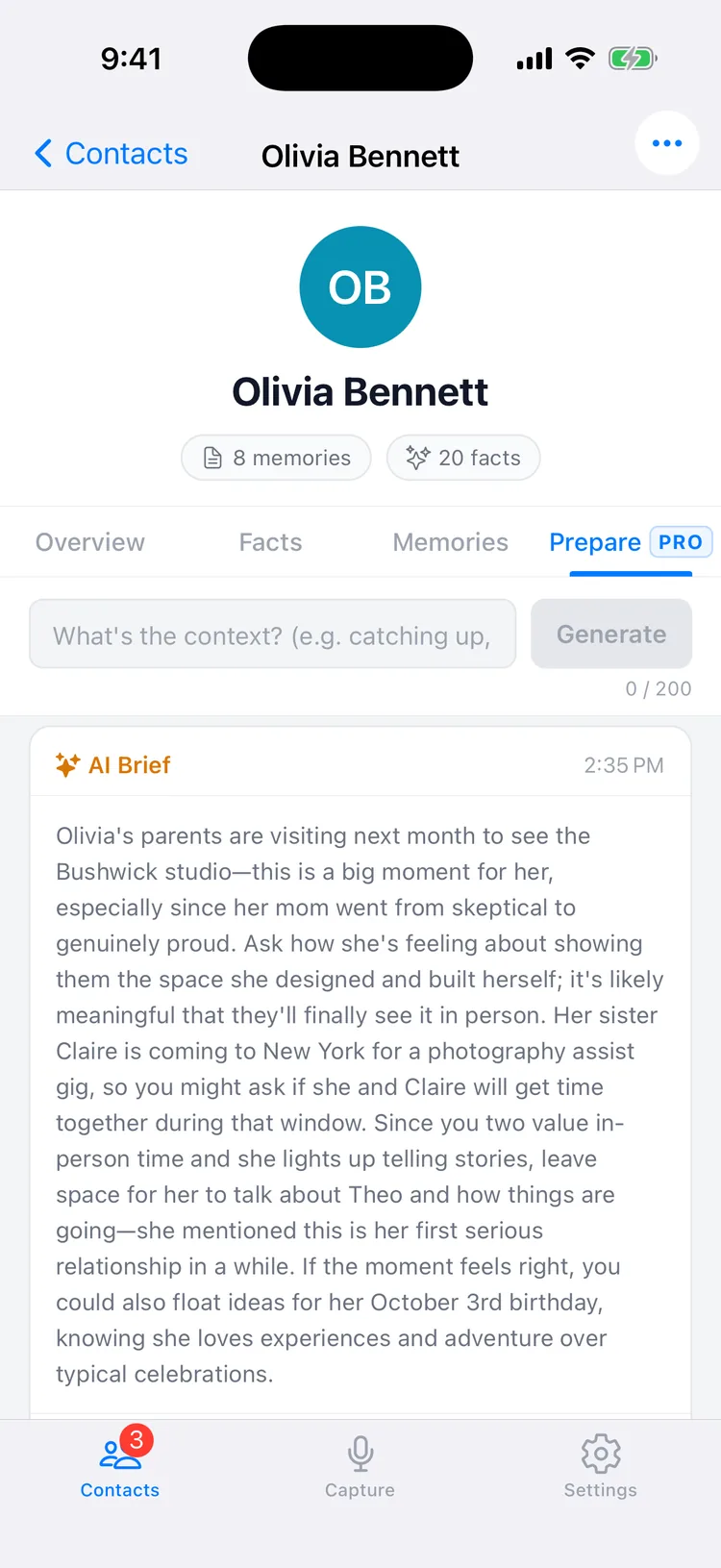
I built Memglow because I wanted that system without the chore. You talk to it for a minute after a meeting and it files everything. Before the next meeting, it writes you a brief from your own notes. And when someone important has gone quiet too long, it taps you on the shoulder. The capture habit is yours to build; the rest is handled.
The bar is low, which is the opportunity
Here's the part I find genuinely encouraging. Most professionals remember almost nothing personal about their clients, and clients know it. The bar is on the floor. Which means the person who asks about Biscuit doesn't seem organized. They seem extraordinary.
Your clients will forgive a late email. They'll forgive a rescheduled call. What they'll never quite forget, in either direction, is whether you knew who they were. Be the one who remembered.