You meet someone at a dinner. The conversation is great. They tell you about their two kids, the company they're trying to get off the ground, the city they just left. You genuinely like this person. Three weeks later you spot them across a room and you cannot recall one single thing they told you. Sometimes not even their name.
For most of my life I took this as proof that I had a bad memory. I'd apologize for it like a character flaw. Then I started reading what memory researchers actually say about moments like that, and it turns out the diagnosis was wrong.
Most of the time, you didn't forget. You never stored it in the first place.
Encoding, not retrieval
Psychologists break remembering into three stages. First your brain has to encode the information, meaning it actually registers and processes it. Then it has to store it. Then, later, you retrieve it. When people say they're bad with names, they almost always assume the problem lives in that last stage. They picture the name sitting somewhere in their head, just out of reach.
But study after study points at the first stage instead. During a conversation, your attention is doing a dozen jobs at once. You're composing your next sentence. You're reading their tone. You're deciding whether to mention the thing you have in common. Encoding requires attention, and attention is exactly the resource a good conversation eats up. The name gets said, your brain never truly grabs it, and there's nothing to retrieve later because nothing was filed.
Names have it especially rough because they're arbitrary. The fact that someone works in commercial real estate connects to a hundred other things you know. The fact that he's called Marcus connects to nothing. Meaning gives memory something to hold onto, and a name has almost none.
The window closes fast
Here's the part that actually changed my behavior. Researchers have been measuring forgetting since the 1880s, when Hermann Ebbinghaus taught himself nonsense syllables and tested his own recall over time. The curve he drew is brutal in one specific way: the steepest drop comes first. You lose the most within the first hours, not the first weeks.
So the details from that dinner aren't fading gently over a month. The unencoded ones are gone before you get home. Whatever survived the conversation starts evaporating in the car.
Once I understood that, my old strategy looked ridiculous. My plan had been to try harder in the moment and hope. But trying harder in the moment splits your attention even more, which makes the encoding worse, which is how I once introduced myself to a man I had already met twice. He was gracious about it. I wanted to disappear.
What actually works
The fix isn't a better brain. It's moving the job somewhere reliable while the window is still open.
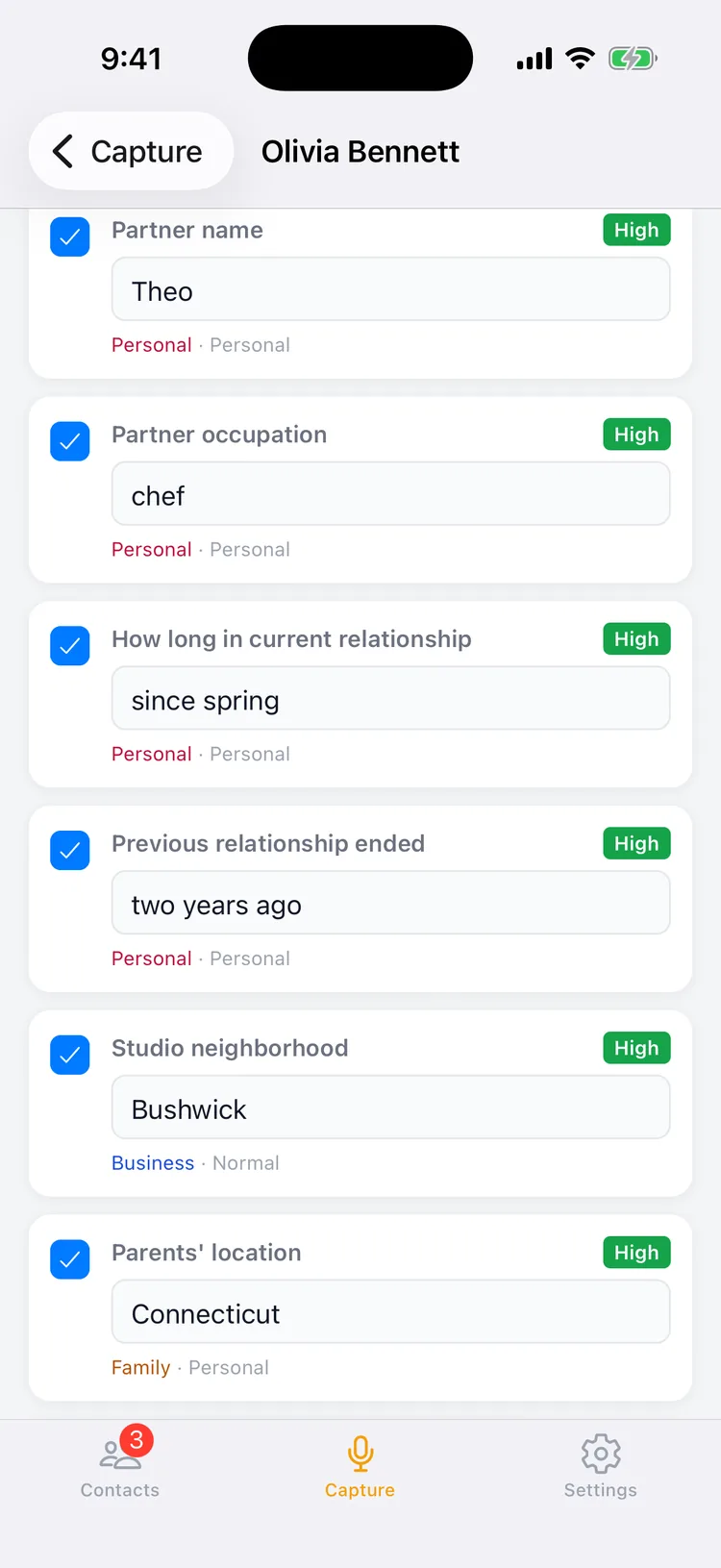
Everything that genuinely helps shares the same shape: it gets the information out of your head and into something permanent, close to the moment it happened. Say the name back when you hear it. Connect a detail to something you already know. And above all, write it down soon after, while it's still there to write down. Not that night. Not tomorrow. Within minutes if you can manage it.
That last habit is the entire reason Memglow exists. It's built around the assumption that you have about two minutes after a conversation before the details start slipping, and that in those two minutes you'd rather talk than type. You say what you noticed, the app pulls out the facts and files them, and the next time you see that person you get to be the one who remembered.
Your memory was never bad. It just never got the raw material. Give it a fair chance and it turns out you can remember everyone.