When we started building relationship health, the first reaction from a few early testers wasn't excitement. It was a flinch. A score on my friendships? Is the app going to tell me I'm a bad friend, and is it reading everything I wrote to decide? Fair questions, both. So before I walk through what goes into the number, let me be clear about what doesn't.
It reads timing, never content
The health score is computed entirely from the shape of your contact over time: when you captured memories, how spaced out they were, and whether your follow ups happened. That's it. It does not read the words inside your notes. Whether you wrote "we had a great talk" or "that was tense," the score sees the same thing, that a memory exists on that date. The intelligence is in the rhythm, not the reading, and that's a deliberate privacy line, not a limitation we haven't gotten around to fixing. If you want the fuller picture of how your words are handled, I laid it out in where your words go.
The whole thing is Memglow's own proprietary algorithm, running on your own data with plain math and no AI call. It costs nothing to compute, and just as important, there's no AI in the loop forming opinions about anyone.
The signals that go in
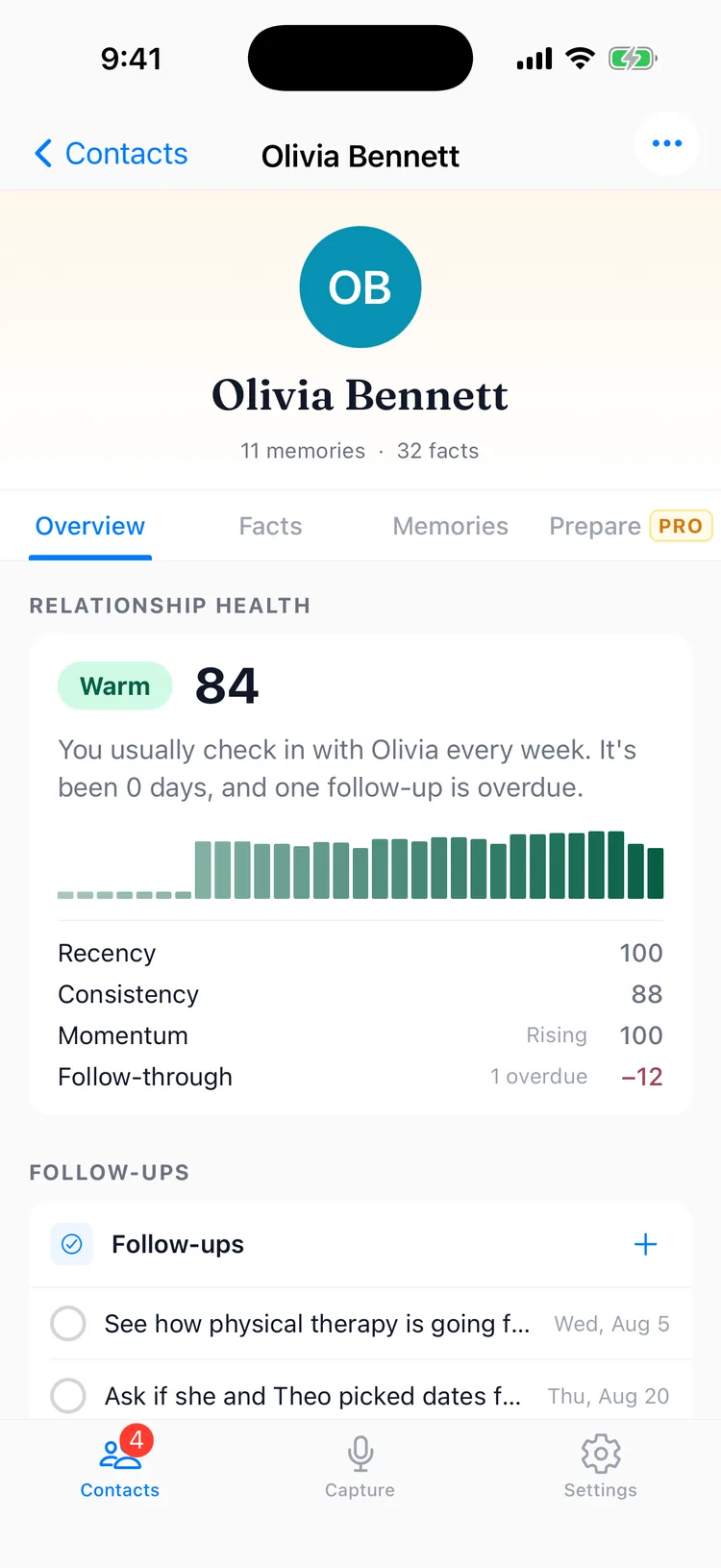
Without giving away the recipe, which is proprietary and took a lot of tuning, the score blends a handful of signals you can see named right on the Overview:
- Recency. How long it's been since your last memory with this person, measured against the pace that's normal for the two of you.
- Consistency. Whether you're in a steady rhythm or a stretch of contact followed by a long silence. A relationship you tend regularly reads healthier than one you binge and abandon.
- Momentum. The recent direction of travel. Things can be a little overdue but clearly warming back up, or fine on paper but quietly fading. Momentum catches the trend, not just the snapshot.
- Follow through. Whether the reminders you set for this person actually happened. Promises you made and kept count for you; ones left hanging pull the read down.
The one input that ties it all together is your own expected cadence. The app learns, or you tell it, roughly how often you and a given person are in touch, and every signal is judged against that. This is why a friend you see weekly and a contact you catch twice a year can both read Warm. There's no universal "good friend" frequency being imposed. The bar is the rhythm that's true for the two of you.
What we chose to leave out
Some things a score like this could do, we decided it shouldn't. It doesn't rank your people against each other into a leaderboard of who matters most. It doesn't judge the emotional quality of a relationship, because a plant that needs watering monthly isn't worse than one you water weekly. And it never leaves your account or feeds a social graph. There isn't one. The whole thing is a private read, for you, about rhythms only you can see.
That restraint is the point. A number that tried to grade your friendships would be both creepy and wrong. A number that just tells you which gardens have gone dry, quietly, using nothing but the dates you already created, turns out to be genuinely useful. That's the line we drew, and it's the one relationship health lives inside.